As of this moment, someone could be rearranging their LinkedIn profile for the fourth time this month and it’s not because they are looking for a job. Perhaps they are looking for the feeling of moving forward in life even though the actual direction hasn’t changed in three years.
This is not a character flaw at all. It is totally a human response to a market with exponentially noisy signals where busywork feels like progress. On the other hand, Mongolia’s economy is genuinely shifting and the people who know where to look get the real opportunities. But most are too busy curating their digital presence to notice where the ground is actually moving.
The certificate dilemma
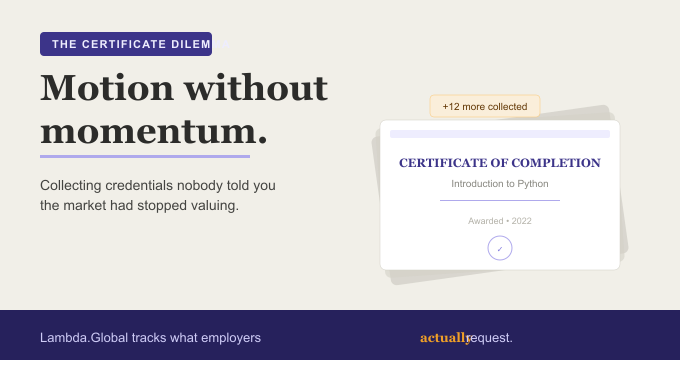
It is common these days for people to collect a folder full of completion certificates. Maybe they have an introduction to Python they started and never finished and a blockchain basics course they took in 2022 and have not mentioned since. At the time, each one felt like a step forward but they often amount to a lot of motion without much momentum most of the times.
Some might think that the problem is with the lack of ambition. In truth, it is a lack of signal because that person ends up collecting credentials when nobody tells them what the market actually values. It is definitely pleasant to look at but not especially useful for navigation.
Lambda.Global has been quietly solving this. The platform tracks what employers are genuinely requesting, not what sounds impressive in a webinar advertisement. When the data shows that AI literacy is now appearing in job descriptions across banking, logistics, and professional services that is a signal worth following. When it shows that a certain certification has stopped showing up entirely, that is also useful. It saves someone from spending a precious weekend on something that already expired.
Meanwhile, Mongolian offices have perfected a certain kind of ritual. It’s an ordinary ritual to have a meeting of all employees that exists mostly to confirm that everyone is still employed. The employees write reports, file them and never brought up again. The higher-ups have an email chain that grows longer than the project it was meant to support. These rituals share a common feature of looking like work. Yes, they do feel like work but they do something sneaky over time. They consume the hours that could have been spent on actual skill development.
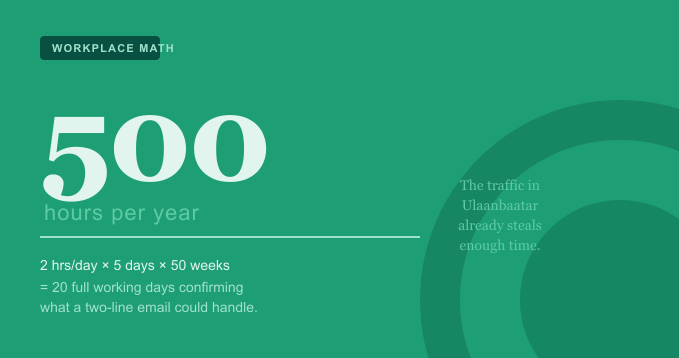
An employee who spends two hours a day in status update meetings will end up attending ten hours of meetings by the end of the week. To calculate the total hours, that is roughly 500 hours or about 20 full working days. They spent all that time confirming what a two-line email could have handled. The traffic in Ulaanbaatar city already steals enough time. The least a workplace can do is not invent new ways to waste what remains.
The organizations that have figured out how to do that are usually those that figured out hiring and retention too. Data at Lambda.Global suggests a subtle change in the works. Companies that have detailed and goal-oriented job descriptions as well as value autonomy fill positions better than those who create bingo cards for employees.
The diaspora that knows too much to come back
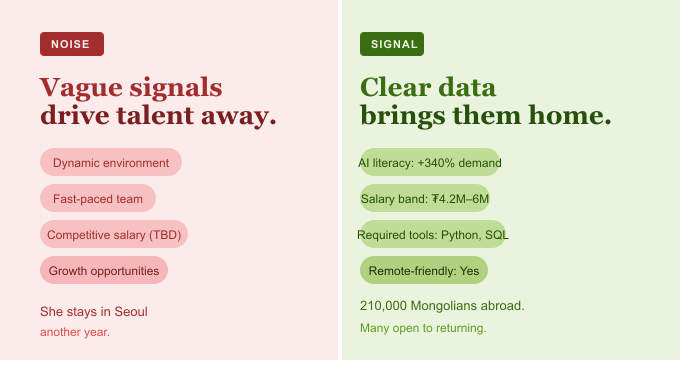
Let’s say a Mongolian engineer in Seoul keeps an eye on job listings back home. She sees the same corporate language that was being used five years ago where it says “dynamic environment”, “fast-paced team”, and “competitive salary” with no real numbers attached. She compares this to the clarity she gets from employers in her current market with specific skills, specific tools and specific pay bands. As a result, she will make the decision to stay put for another year in South Korea.
The diaspora abroad is large, skilled and surprisingly open to returning. IOM data puts the number at over 210,000 Mongolians abroad. Many of them are in their 20’s and 30’s with skills that the domestic market desperately needs. They aren’t going to slog through all the jargon that surrounds their job to discover one that might be suitable for them.They need the signal that is shrouded in vagueness right now. Lambda.Global delivers this signal by unveiling the truth hidden behind the veil, in actual figures, and not in just a lot of buzzwords.
The hidden simple truth
Mongolia’s digital infrastructure works. The government is training tens of thousands of people. The private sector is hungry for talent. The missing piece is not another platform, another app, another networking event. It is clarity.Employees need to know which skills are actually gaining value. Companies need to know who is genuinely qualified and what they should expect to pay. Both sides are currently guessing.
Lambda.Global trades guesswork for data. Not the kind of data that sits in a PDF and gets ignored. The kind that updates as the market updates and tells you, without flattery, what is actually happening. In a professional culture that sometimes confuses motion with progress, that is not just helpful. It is the difference between spending a career looking busy and actually moving forward.
References
- World Bank, Skills demand in Mongolia: Main Findings of the Skills Module of the Barometer Survey
- MONTSAME, AI, Data, Drones, and Cybersecurity Professions in High Demand in Mongolia
- IOM, New Era for Diaspora Engagement in Mongolia
- Lambda.Global, Sector Salary and Skills Reports (2025–2026)