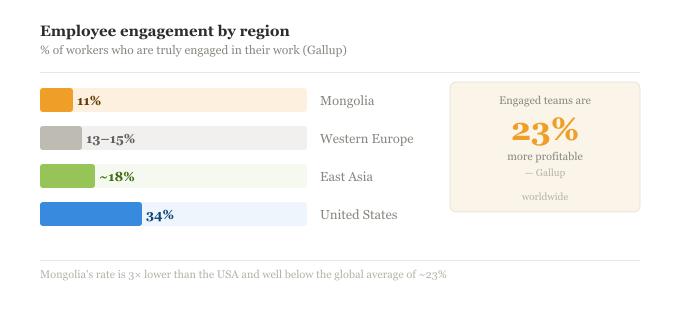
Mongolia has a problem with workers who are not really into their jobs. 11% Of Mongolian workers are truly engaged in their work. This is according to Gallups global workplace survey. To understand what it means to be engaged it is more than showing up to work. It means you actually care if your projects succeed or fail. You want to help make things better. You are invested in your work.
So what about the 89% of workers? They are not really into their work. Some just show up. Do the minimum and some might even want their company to fail. This is a problem for managers and it affects a lot more than just the payroll.
It is also important to note that being engaged does not mean you are happy. You might like your office. If you do not care about your work, you are not engaged. Engaged workers treat the company’s problems like their problems. They want to help fix things and make things better not just because they are afraid of getting in trouble.
Gallup found that teams that are really engaged are 23% more profitable. This is true for companies around the world. In Mongolia the employee engagement rate is 11%, which is very low. In the USA the rate is 34%. This means that 11% of workers in Mongolia really care about their work and want to do a good job. The other 89% of workers are not really invested in their work. They might just be doing the minimum. They might be doing worse. This is not a small problem it is a big deal. It affects the economy in ways that’re hard to measure.
Engagement is not the same as happiness. Happy workers can still not be engaged. Engaged workers make the company’s problems their own problems. They want to fix things and make things better. If an employee gets an email on a Friday afternoon, they might reply away because they want to get it done not just because they are afraid of their boss.
Gallups research shows that Mongolia is behind the rest of the world when it comes to employee engagement. In the US 34% of workers are engaged. In Western Europe it is 13-15%. In East Asia it is even higher. This is not a cultural thing it is a sign of a bigger problem with how companies hire and treat their employees.
When workers are not engaged it can be very costly. It is not always obvious. It can sneak into little things like meetings starting late or reports being turned in on time but not being very good. Worldwide Gallup says that disengagement costs the economy $8.8 trillion in lost productivity. In Mongolia the exact cost is not known. It is likely to be very high.
What is really concerning is that many disengaged workers just stick around. They do not quit. They do not do a very good job either. They take up space that could be filled by someone who’s actually enthusiastic about their work. In Ulaanbaatar’s job market this just keeps a cycle of mediocrity going.
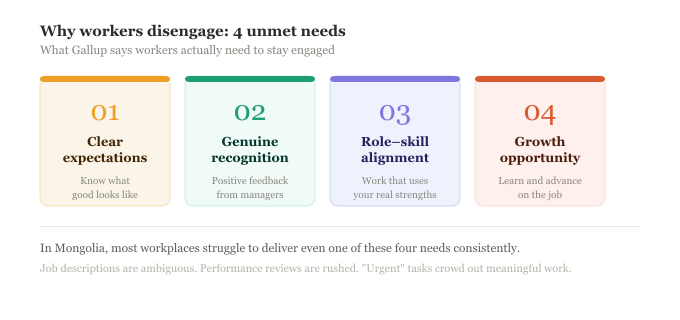
So why do people disconnect on the job? The reasons are surprisingly simple, Gallup surveys suggest workers need clear expectations, positive manager recognition, roles where their skills are used effectively, and opportunities to learn and grow.
Consider how many Mongolian workplaces are actually achieving these four things. Job descriptions are generally ambiguous, performance reviews occur perhaps once a year in a rushed discussion, and important tasks are put on hold in favor of a never-ending stream of “urgent” matters which have little to do with an employee’s defined role.
What has occurred is that people are simply showing up to work without being engaged. This isn’t because people are inherently lazy or apathetic. It’s simply because employers are failing to foster genuine engagement and no one is quantifying the true cost of this failure.
How the right match changes things
Engagement is fundamentally about a match. A professional who lands a role aligned with their capabilities where the expectations are clear, and pay ranges are disclosed openly, is practically engaged before the first day even begins. Achieving this perfect fit is a challenge in today’s market of fragmented information.
This is precisely where Lambda.Global provides a solution: it’s not necessarily about fixing disengagement, but it certainly elevates the chances of a strong match being made. Providing clear salary information in job listings allows both employers and candidates to bypass the complicated guesswork of salary negotiations. Asking candidates to pass tests based on skills rather than the beauty of their CVs automatically weeds out the unsuitable. Providing ongoing market information on skill value and demand enables professionals to focus their energies and training efforts where they are truly needed in the economy.
The most telling factor on the Lambda.Global platform is the amount of time saved. Job listings where clear salary information is available and where a wide range of candidates are encouraged to apply are filling up in a fraction of the time they typically take through traditional means. The speed itself is not important; the match quality is.
A speedy hire implies that a suitable candidate has seen and deemed the offer worthwhile. This correlates directly to the increased employee engagement in that individual’s role. Conversely, a lengthy, protracted job search and subsequent low-quality hire that ultimately ends up in a problematic situation for both sides will often result in high employee turnover come the following year.
A small change that yields enormous results
Double the engagement rate overnight simply isn’t in the cards; we’ve been at 11% for years and it’s going to take years to climb. However, massive national initiatives and cultural overhauls aren’t required to spark this change. Most business improvements happen when employers are armed with the right information. Companies need to know the going market rate for a position to extend competitive offers. Employees need to understand which skills are truly in demand in the economy to avoid wasting time and money on pointless certifications.
Lambda.Global provides this vital information. Unlike companies focused on motivational buzzwords and thought leadership blogs about work-life balance, it taps into constantly updated real-time data driven by market demands. Ultimately, the 89% of disengaged workers in Mongolia aren’t a lost cause, they are simply waiting for good reason to care and the right match may be a start to it.
References
- Gallup, State of the Global Workplace Report
- Gallup, How to Improve Employee Engagement in the Workplace
- Lambda.Global, internal placement data (2025–2026)