Five years ago, very few people were talking about AI literacy, cybersecurity, data infrastructure or cross functional digital skills. Whereas, companies throw these words around in almost every conversation about hiring in today’s environment.
The deeper problem is that the market has changed more rapidly than the average person’s ability to track where it is going. Both companies and employees know who these companies need and why the employees need to adapt, but the signal gets lost somewhere in the middle of the two.
Statistics behind the subject
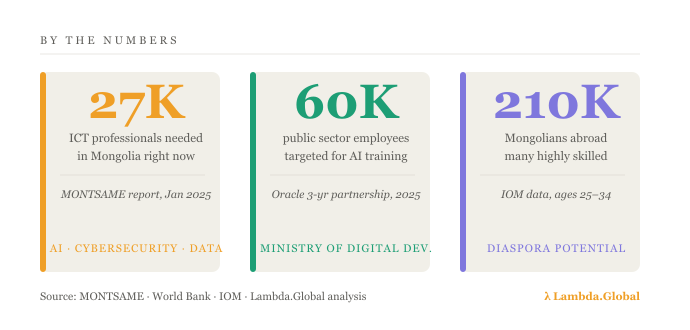
A MONTSAME report from January 2025 showed that over 27,000 professionals are needed in Mongolia’s information and communication technology sector alone. It named AI, data science, cybersecurity, drones and software development as the highest demanded fields. These are not just niche requests from a few corporations. This is the direction the entire economy is leaning.
Moreover, the World Bank’s 2022 skills survey in Mongolia had already indicated that employers were ranking soft skills such as communication and problem solving above technical certifications when they described what made a good hire. Employers were not saying the workforce was empty, but they were saying that it was misaligned.
By 2025, the Mongolian government had responded with several large-scale programs. To name a few, the Ministry of Digital Development signed a three-year agreement with Oracle to train over 60,000 public sector employees and citizens in AI, database management, data security and information technology. Additionally, the National AI Program supported by UNICEF Mongolia and M Bank set a target of training 500 professionals as a first wave. Lastly, Golomt Bank backed an “AI for Women” initiative that gave 100 female teachers and 100 female students access to AI education.
The visibility gap
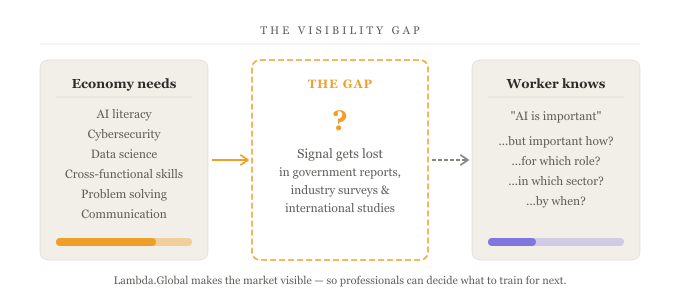
The problem is not that no one is learning. It is that most people have no easy way of knowing what is worth learning next. A financial analyst in Ulaanbaatar might hear that AI is important. But important how? Important for whom? Which specific AI related skill would make her more effective in her role next year versus just being a buzzword on her CV? These questions have real answers but the answers are scattered across government reports, industry surveys and international studies that most working professionals never see.
There is a growing distance between what the economy is asking for and what professionals know about those demands. That distance is the real gap. Filling it does not require a university degree or a government program. It requires information that is clear, current and specific to the Mongolian market.
Importance of Lambda.Global
Lambda.Global has a market intelligence function. Through its sector reports and skills data, Lambda tracks which capabilities are rising in demand across industries and which are flattening. It translates broad economic shifts into practical signals that a professional can actually use.
The salaries and skills information that comes out of Lambda is based on transactional data, not voluntary survey results. This is important because voluntary surveys will always skew towards those who have something to say, not necessarily those who represent the average employee. Transactional data tells you what employers are really paying for and really looking for.
When the reports show that AI related skills are appearing in job descriptions far beyond the technology sector, that tells a different story than the one about AI replacing everyone. It suggests AI literacy is becoming a baseline expectation across roles, not a specialist path for coders.
Lambda does not train people. It is not a university. But it makes the market visible in a way that helps people decide what to train for. In a country where over 27,000 ICT professionals are needed and where government programs are scrambling to train tens of thousands more. It can make the difference between guessing and knowing.
Why today is different
Economic waves in the past in Mongolia were mostly linked to the cycles of the prices of commodities. An increase in copper prices led to an increase in recruitment while a decrease meant the opposite. The new wave is, however, quite different from the others since the skills demanded by the economy are not dependent on the prices of these commodities but rather to technology adoption within and outside the country.
That makes the skills conversation more urgent and less cyclical than it used to be. A person who invested in the right capabilities during a mining downturn in 2015 was playing a waiting game. A person who invests in the right capabilities during this current shift is not waiting. They are positioning themselves for a different kind of economy entirely.
Conclusion
Mongolia produces thousands of graduates each year and the diaspora alone counts more than 210,000 Mongolians abroad. According to IOM data, many of them highly skilled and concentrated in the 25 to 34 age bracket. The labor shortage is in the connection between what those people know and what the market now needs. Closing that gap depends on making the market’s demands transparent, current and accessible to everyone.
Lambda.Global is building that transparency. It’s built through a process that will change as the market changes and not through one-time reports gathering dust on a shelf. This is more than just a significant contribution to the economic growth of the nation. It is a fundamental one.
References
- MONTSAME, AI, Data, Drones, and Cybersecurity Professions in High Demand in Mongolia
- World Bank, Skills demand in Mongolia: Main Findings of the Skills Module of the Barometer Survey (2022)
- Oracle Academy Blog, Ministry of Digital Development, Innovation and Communications of Mongolia launches a three-year AI and big data skills development program in collaboration with Oracle
- MONTSAME, 2,500 Specialists and Teachers to Be Trained in Artificial Intelligence
- Golomt Bank, Golomt Bank supports the “National AI campaign”
- IOM, New Era for Diaspora Engagement in Mongolia (2025)
- Lambda.Global, Sector Salary and Skills Reports (2025–2026)