This is not an essay or a guide. I want to provide just a handful of things the numbers are saying that most people have not heard yet.
1. 53% of the workforce is in the wrong job
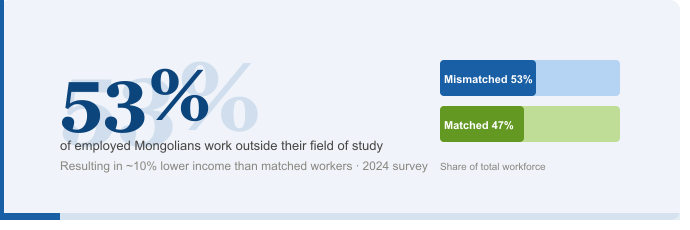
A survey conducted in 2024 found that 53% of all employed individuals are working in fields that have nothing to do with what they studied for in Mongolia. As a consequence, their incomes are about 10% lower than people whose jobs match their qualifications.
It is unfortunately a structural drag because when more than half a workforce is misaligned, productivity stays stagnant regardless of how hard individuals work. In order to address this specific issue, the Ministry of Family, Labor and Social Protection declared 2026 the “Year of Employment Promotion”.
2. The government is not waiting, it is building
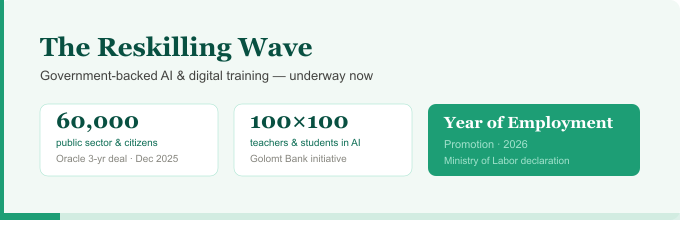
In December 2025, the Ministry of Digital Development signed a three-year agreement with Oracle. The overall plan is to train over 60,000 public sector employees and citizens in artificial intelligence, database systems, data management, data security and information technology in order to free access at a nationwide level.
In addition to that, Golomt Bank supported the launch of an “AI for Women 100×100” initiative. One hundred women teachers. One hundred women students. Organized AI training sessions from secondary schools throughout the country.
The Prime Minister himself has advocated for a national “reskilling wave” initiative, recognizing the reality that artificial intelligence and digitalization are not something in the future. They are here to change the job landscape, eliminating some while creating others. This is no longer about experimental programs but the start of something big.
3. The diaspora is younger and more educated than most people think
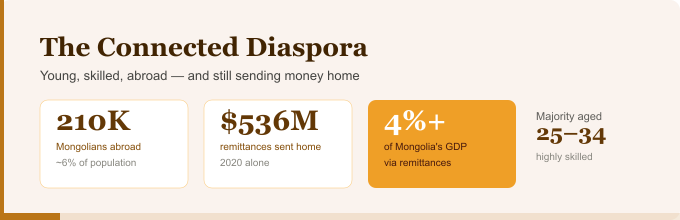
Over 210,000 Mongolians live abroad which is about six percent of the entire population. Most are concentrated in the 25 to 34 age bracket and many are highly skilled professionals with experience and high labor productivity. In 2020 alone, Mongolians abroad sent back USD 536.2 million in remittances, equal to more than four percent of the country’s GDP.
These are not people who left and forgot, but the ones who left and stayed connected. The question is whether the home market knows how to reach them.
4. Even traditional sectors are feeling the skills squeeze
The cashmere industry, a sector Mongolia has built its reputation on, is short of workers. An ILO survey conducted in 2025 with nearly 600 respondents found labor shortages of 10 to 20% across the sector. The shocking news is that the jobs were there, but the applicants just did not match. The same pattern repeats in fintech, logistics and professional services. It is not one industry in trouble anymore. It is a whole economy where the supply of skills and the demand for skills are not meeting.
5. Nobody has connected all these dots in one place
Let’s take it all by looking at it simply. The Ministry of Labor publishes forecasts, the World Bank publishes surveys, Coursera publishes global skills reports, Oracle and Golomt Bank run training programs and IOM tracks the diaspora. It is clear that the data exists, but in a scattered form across dozens of sources. As a result, most working individuals never end up seeing these.
This is the gap Lambda.Global is filling. Not by becoming a training provider or a government agency, but by making the market visible. Lambda tracks what employers are actually requesting, which skills are gaining demand and where compensation is really landing. It turns these scattered information into something a person or a company can use.
In 2025, Lambda’s own salary data shows the median wage in Mongolia reached 2.88 million MNT. However, the average compensation sits higher between 4 and 5 million MNT on the Lambda platform itself. That gap tells its own story about how the market is not flat. It is deeply segmented and knowing which segment you are in changes everything.
6. The future ahead
The government is training tens of thousands at present. Firms are updating their job profiles to ensure that candidates possess AI and cross-discipline skills. Diasporas are becoming more educated and larger in size. The discrepancy between knowledge and economy remains wide open.
Lambda.Global does not close that gap by itself. In fact, no platform can. But it gives people a clear view of the gap so they can decide for themselves where to step next. It is the one advantage that most professionals and most companies in Mongolia are not using yet.
References
- Ministry of Labor and Social Protection / MONTSAME, Additional Jobs Centers to Be Established Nationwide
- Ministry of Family, Labor and Social Protection, Year of Employment Promotion
- Oracle Academy Blog, Ministry of Digital Development launches three-year AI and big data skills program with Oracle
- Golomt Bank, Golomt Bank supports the “National AI campaign”
- Mongolian National Chamber of Commerce, Supporting and Collaborating with the Prime Minister’s Policy
- IOM, New Era for Diaspora Engagement in Mongolia
- IOM Mongolia, IOM in Mongolia – USD 536.2 million in remittances in 2020, 4.07% of GDP.
- ILO, Survey finds job quality key to attracting youth to Mongolia’s cashmere sector
- Lambda.Global, Salary Trends and Compensation Insights in Mongolia