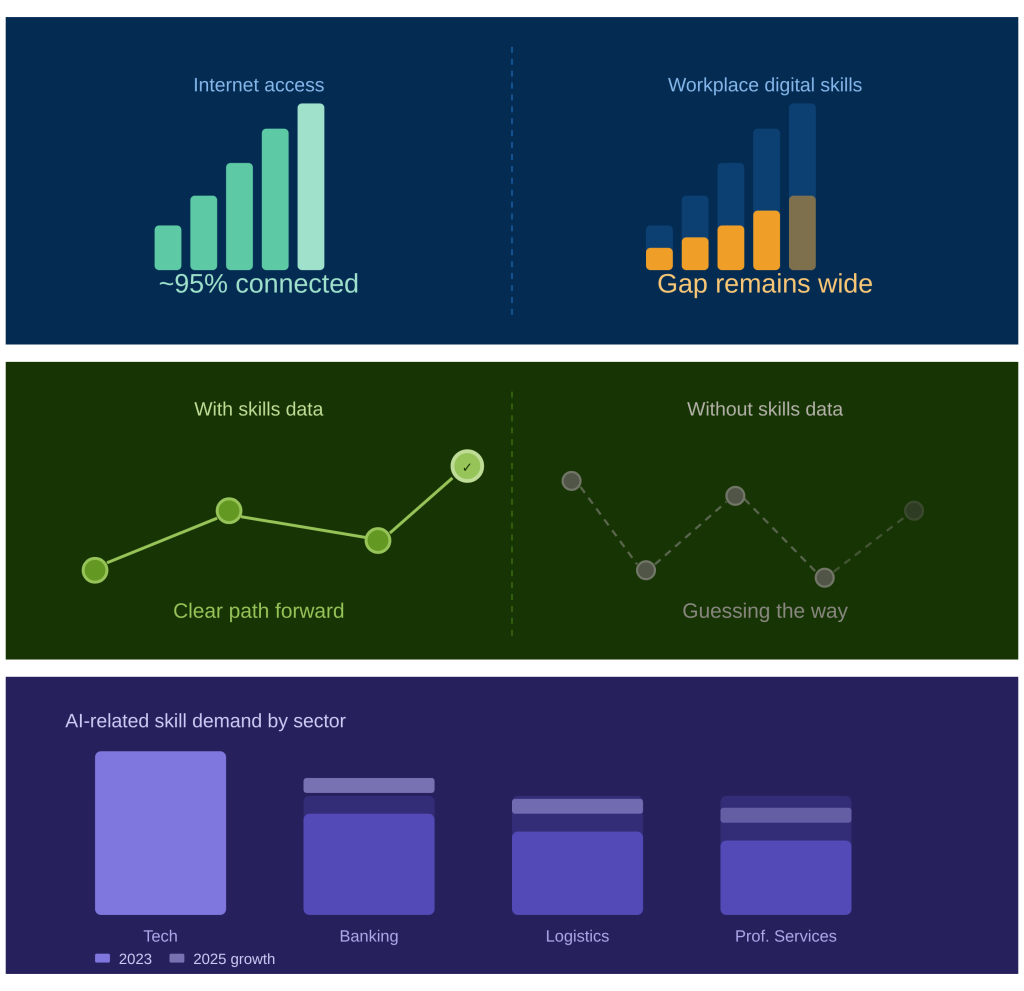
If we look at the history, most of Mongolia is connected to the internet and has been that way for many years. The numbers are genuinely impressive for a country of this size and geography in which about 2.8 million people are online. It is incredible that a child in Khovd province can be inspired by the same article mentioning art as a student in Seoul.
However, there is a quiet gap opening up across Mongolia’s workforce. It is about who knows how to turn all that connectivity over the world into something that actually advances their work. The problem is not access, but a digital literacy in the deepest sense. Not knowing what Brave browser is fine. But knowing which tools matter, which skills are gaining value and which learning paths lead somewhere real is the key.
The data that should worry us
The World Bank’s 2022 skills survey painted a picture that is easy to misread. Employers ranked soft skills such as problem solving and communication above technical qualifications. That finding gets quoted often because it sounds reassuring. Although it suggests people with skills still win, it also contains a quieter message. As matter of fact, employers reported that many new hires struggled with basic digital problem solving in a workplace setting with things like troubleshooting a shared document, adapting to a new software without any training or using data tools beyond Microsoft Excel. These are the minimum requirements for a workplace where digital tools change every eighteen months and these are not advanced technology skills.
Another global study conducted by the OECD in 2023 also focused on the level of digital literacy of adults in various countries. The result is that there is no correlation between the ability to use social media or messaging applications and professional collaboration tools, data security and learning new programs. While the former skill was widespread, the latter were unevenly distributed. Even though this particular study did not include Mongolia, it correlates with the description provided by local businesses regarding the readiness gap among new employees.
Meanwhile, the government is pushing forward. The Oracle training deal signed in December 2025 will eventually reach over 60,000 people and the National AI Program has trained hundreds already. However, these efforts mostly target public sector employees and teachers. The private sector employees are largely left to figure things out alone without any guidance.
The person who figures it out first wins
What separates the people who stay ahead from the people who fall behind is not access to training. It is the information about which training is worth their time. Let’s say a marketing manager hears that AI is important and she has three hours free each week. Does she spend it learning how to prompt ChatGPT effectively for a future campaign or does she dive into a data analytics course that may or may not be relevant to her next role? One path sharpens a skill her employer already needs and the other adds a line to her CV that nobody really asked for.
This is where market intelligence stops being a luxury and becomes a personal necessity. A person who knows which skills are rising in demand will have a map to follow. Everyone else is walking around with a blindfold. Lambda.Global is building that map. The platform’s skills data and sector reports track what employers are actually requesting, not what they said in a survey two years ago.
When the data shows that demand for AI-related skills has spread far beyond the technology sector into banking, logistics, and professional services, that is a signal worth paying attention to. When it shows that certain certifications are appearing less often in senior job descriptions, that is also a signal. The platform tells people what the market is quietly asking for so they can make their own decisions with their eyes open.
Why this has nothing to do with education
It is common for people to blame the education system whenever a skills gap appears. Sure, it isn’t entirely wrong to blame. Mongolia’s universities are still working to align their curricula with what the economy now needs. In reality, waiting for the education system to fix itself is not a valid strategy for people who wants to remain employable for the foreseeable future.
The term continuous learning is one that everyone nods their heads to and few practice in actuality. The truth is that the most successful students are not those who block off entire weekends for classes. They are the ones who find the time every day to read something about a new program or application. Incremental exposure builds up into something resembling muscle memory for technology.
This is also not a talent problem. Mongolia produces thousands of graduates every year. The diaspora alone counts over 210,000 Mongolians abroad. The challenge is making sure that the raw material stays sharp and stays connected to what the economy is genuinely demanding. Lambda.Global does that by giving both employees and companies a view of the market that updates continuously rather than a static report.
Final thought
Mongolia’s digital infrastructure is already good enough. The missing piece is more clarity. Clarity about which skills the economy is actually rewarding, which tools are worth investing time in and where the opportunities are opening up for people looked for it. Lambda.Global provides that clarity. Not with opinions, but with data. And in a country where most people are still guessing, that is not a small advantage. It is the whole game.
References
- World Bank, Skills demand in Mongolia: Main Findings of the Skills Module of the Barometer Survey
- OECD, Skills Outlook 2023: Skills for a Resilient Green and Digital Transition
- Oracle Academy Blog, Ministry of Digital Development launches three-year AI and big data skills program with Oracle
- IOM, New Era for Diaspora Engagement in Mongolia
- Lambda.Global, Sector Salary and Skills Reports